
When it comes to AI in high school research, today’s students aren’t deciding whether to use these tools — they’re deciding how. Artificial Intelligence is everywhere: drafting emails, summarizing articles, explaining tough chemistry problems, and yes, sometimes writing entire papers. Most teens now understand that AI can’t (and shouldn’t) ghost-write their college essays. But the harder question is where the appropriate line actually sits. Can AI help with background research? Lab reports? Science fair data analysis? College prep? That’s the conversation we wanted to have — and we brought in one of the best people in the country to have it with.
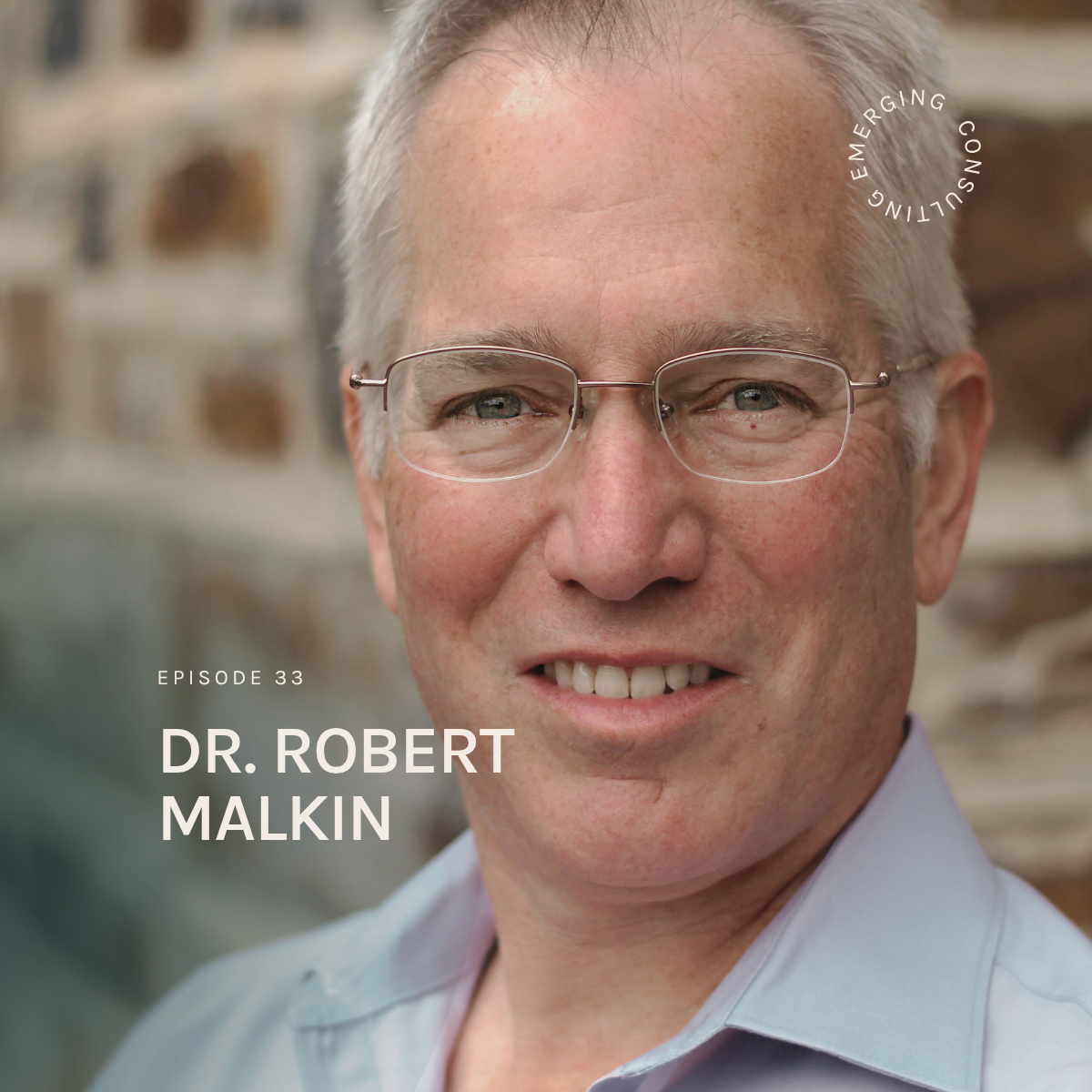
In this episode, Emerging Consulting founder Laura Barr sat down with Dr. Robert A. Malkin, PhD, PE, Professor of the Practice of Biomedical Engineering and Global Health, Emeritus, at Duke University and Academic Director of the International Research Institute of North Carolina. Dr. Malkin works with high school researchers every year and literally wrote the book on academic research for teens. Together, they unpack where AI thoughtfully supports learning — and where it quietly undermines the skills students are supposed to be building.
Listen to the Full Conversation
Is AI Really “New” in Science?
One of Dr. Malkin’s opening points reframes the whole conversation: AI isn’t new to science. Statistical modeling, machine learning, and pattern recognition have been part of serious research for decades. What is new is the arrival of generative AI — tools like ChatGPT, Claude, and Gemini — in the hands of every 15-year-old with a laptop. That shift is what’s forcing families, teachers, and colleges to rewrite the rules in real time.
Understanding this history matters because it changes the question. We’re not asking “should students use AI?” — they already do, in nearly every field they’ll enter. We’re asking which uses develop their thinking and which uses shortcut the exact cognitive work they need to be doing.
Generative vs. Assistive AI: Why the Distinction Matters
Not all AI is the same, and this distinction is the single most useful framework for families trying to set household rules around AI in high school research.
- Generative AI creates content from scratch — a full essay, a summary, a fabricated paragraph of analysis. When a student asks ChatGPT to “write an introduction to my research paper on coral bleaching,” that’s generative.
- Assistive AI supports a student’s own thinking — grammar checks, translation, data visualization, transcribing an interview, suggesting a citation format, or checking the math on a statistical calculation the student already set up.
The line isn’t always clean, but the principle is: if the AI is doing the intellectual work the assignment is designed to teach, that’s a problem. If the AI is removing friction around work the student has already done, that’s usually fine. This is similar to the distinction we explored in our post on your teen’s brain on ChatGPT, which unpacks what happens in the brain when AI replaces effortful thinking.
Where AI Belongs in High School Research
Dr. Malkin is clear that AI has real, legitimate roles in high school research. Used well, it can raise the ceiling of what a student is capable of producing. Used poorly, it collapses the floor of what they actually learn.
Areas where AI is generally appropriate:
- Background research and orientation. Using AI to get a quick overview of a dense topic before diving into primary sources is similar to reading a textbook introduction. The student still has to do the real reading.
- Data analysis and graphing. For science fair projects, AI can help students visualize large datasets, check calculations, or learn an unfamiliar statistical test. The insight still has to come from the student.
- Literature reviews. Increasingly common in college applications for research-track students. AI can help students locate and summarize existing studies — but the synthesis and critique must be their own.
- Language translation. Translating primary sources, interview transcripts, or academic papers from other languages opens up research that would otherwise be inaccessible.
- Researching colleges before visits. Generating questions to ask tour guides, summarizing a department’s faculty research interests, or comparing program curricula are all fair uses.
Where AI Crosses the Line
The harder territory is where AI silently replaces the thinking an assignment is supposed to develop. Dr. Malkin flagged several red-zone uses that parents and students should be explicit about:
- Generating original analysis. If the goal of a lab report is to practice interpreting data, asking AI to write the interpretation hollows out the assignment.
- Writing college application essays. AI cannot generate a meaningful personal statement because it has no access to the student’s actual life, voice, or values. More on this below.
- Fabricating sources or citations. AI tools routinely invent plausible-sounding references that don’t exist. Using these in a paper is academic dishonesty, whether intentional or not.
- Passing off AI-written prose as student writing. Even if the ideas started with the student, submitting AI-generated text as original work violates the academic integrity policies of nearly every high school and college.
The Common App has been explicit: applicants must submit work that is their own, and generative AI complicates that commitment in ways students need to take seriously.
AI and College Applications: What Admissions Officers Are (and Aren’t) Doing
One of the most practical parts of the conversation was Dr. Malkin’s reality check on how colleges are actually handling AI. Some admissions offices use AI-assisted screening tools for the initial read of applications. Others don’t. Detection technology exists, but it’s imperfect. The more reliable signal, as Dr. Malkin points out, is the mismatch between a student’s voice across their application — essays that don’t sound like the teacher recommendations, personal statements that don’t match the student’s interview, supplemental essays that suddenly sound like a different person.
This is the core reason AI can’t write a strong application essay. The College Board and virtually every admissions office emphasize specificity, voice, and personal reflection — all of which require the student’s actual life as raw material. AI has none of it. For more on this, see our deeper dive on future-proofing your path in an age of AI.
Frequently Asked Questions About AI in High School Research
Can my student use AI for background research on a paper?
Generally, yes — with limits. Using AI to get oriented on a new topic is similar to reading a Wikipedia entry or a textbook chapter. The key is that students should treat AI summaries as a starting point, not a source. Every important claim should be verified against a primary source, and citations should come from the original material, not from AI.
Is it okay for students to use AI on their college application essays?
Using AI to brainstorm, reverse-outline a draft, or check grammar on the student’s own writing is generally acceptable. Asking AI to generate the essay, rewrite a paragraph in a “better” voice, or fill in personal experiences is not. The essay has to sound like the student — and admissions officers are increasingly good at noticing when it doesn’t.
How do colleges detect AI-generated application content?
Detection tools exist but are unreliable. The more consistent signal is voice mismatch: an essay that doesn’t align with the student’s teacher recommendations, interview, or supplemental writing. Admissions officers read thousands of applications and develop a strong instinct for authentic student voice. Trying to outsmart them is a losing bet.
Can AI help students research colleges before visits?
Absolutely. AI can generate thoughtful questions to ask tour guides, summarize a department’s research focus, compare curricula across schools, or flag programs the student hadn’t considered. This is one of the cleanest, most useful applications of AI in college prep.
What’s a safe way to let my teen use AI for schoolwork?
Start with transparency: tell teachers when AI is used and how. Use AI as a study partner, not a ghostwriter — to explain concepts, quiz the student, check work, or translate material. Keep the student’s original thinking and writing at the center. If the AI is doing the thinking the assignment is designed to teach, it’s the wrong tool for that moment.
Key Resources from Dr. Malkin
- A Guide to Academic Research for High School Students by Malkin & Hale — with a second edition coming soon.
- IRI-NC Programs — learn more about the International Research Institute of North Carolina’s research opportunities for high school students.
- Apply Now — direct link to IRI-NC applications.
About Dr. Robert A. Malkin
Dr. Robert A. Malkin is Professor of the Practice of Biomedical Engineering and Global Health, Emeritus, at Duke University, and Academic Director of the International Research Institute of North Carolina. His career has included faculty and research roles at Duke, the University of Memphis, the University of Tennessee, The City College of New York, and Columbia University. He is the founder of Engineering World Health and The Global Public Service Academies — organizations dedicated to improving healthcare in the developing world — and has served as an expert advisor to multiple World Health Organization committees focused on healthcare technology and innovation.
More from Emerging Consulting on AI
This conversation is part of an ongoing series we’ve been building on how AI is reshaping high school and college admissions. If you found this helpful, these are worth your time:
- College to Career: How to Future-Proof Your Path in an Age of AI and Uncertainty
- Your Teen’s Brain on ChatGPT: What the MIT Study Reveals — and How Parents Can Respond Thoughtfully
- Unlocking Potential: How AI and Tutor-Supported Test Prep Are Empowering Students with ADHD
- The Future of Test Prep: How AI is Changing the Game
- Episode 18: Ace Your Future — How AI is Revolutionizing Test Prep & College Admissions
- Episode 17: How (and Why) High Schoolers Should Get Involved in AI
Continue the Conversation
Navigating AI in high school research is a moving target, and the right answer this year may not be the right answer next year. What stays constant is the goal: students who leave high school having done real thinking, produced real writing, and developed real skills. If you’re thinking through how to support your teen through this shift — academically, in their applications, or through executive function coaching — we’re here. Explore our college consulting services or reach out to start a conversation.